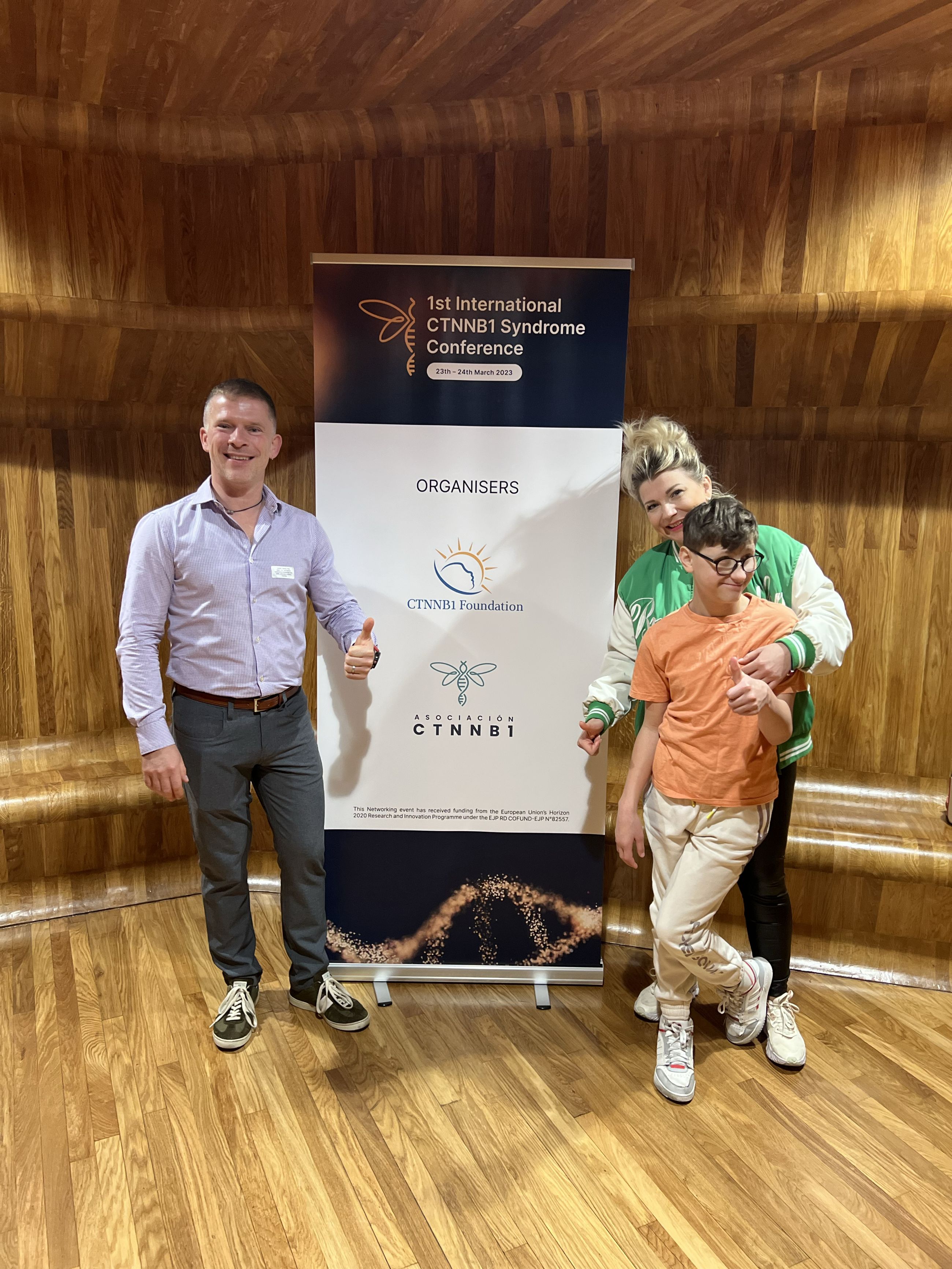
TWO scientists from Children’s Medical Research Institute have described the “rewarding experience’’ of presenting at a rare disease conference in Spain and meeting the families that their research aims to help.
Head of CMRI’s Translational Vectorology Unit Associate Professor Leszek Lisowski and research officer Dr Andrea Perez-Iturralde travelled to the first ever International CTNNB1 Syndrome Conference held in Madrid.
CTNNB1 Syndrome is a rare neurodevelopmental disorder that can produce developmental delay, intellectual disability, visual defects, autistic behaviours, and speech delay. The conference was organised by the CTNNB1 Foundation’s president Spela Mirosevic whose son Urban lives with the condition.
Associate Professor Lisowski has been working on a gene therapy for this condition thanks to funding from the Foundation. He spoke alongside experts from Europe, Asia, and the US.
“The meeting allowed us to make critical connections with researchers, which will lead to future research projects into CTNNB1 and other disorders,’’ Associate Lisowski said. “Most importantly, there were families from all over the world. It was also really great to meet the families. While they all share the same problem – the lack of valid medical treatment for their precious children.’’
Associate Professor Lisowski and Dr Perez-Iturralde are hoping to change that with the possibility of gene therapy to compensate the genetic error with one simple injection.
“It was a critical eye-opening opportunity that will benefit me, and Andrea, when working towards therapy for CTNNB1 but also other genetic disorders. It was good to hear what problems they are facing and understand their unique perspectives.’’
Dr Perez-Iturralde said it reminded her why she became a scientist.
“It was a powerful reminder of why we do what we do as researchers and how our work can have a meaningful impact on people's lives,’’ she said.
“One of the most impressive aspects of the CTNNB1 Foundation’s work is the high-quality research they have been coordinating around the world.”
“Despite the fact that CTNNB1 Syndrome was only discovered 10 years ago, there has been a significant amount of research conducted into this condition, thanks in large part to the CTNNB1 Foundation's efforts."
“In this conference we were able to share some of our research findings and advancements in the development of a gene therapy treatment for CTNNB1 Syndrome.”
“By sharing our research findings and insights into CTNNB1 Syndrome, I hope we have given families the tools they need to advocate for themselves and their loved ones, and to ensure that they receive the best possible care and support.’’