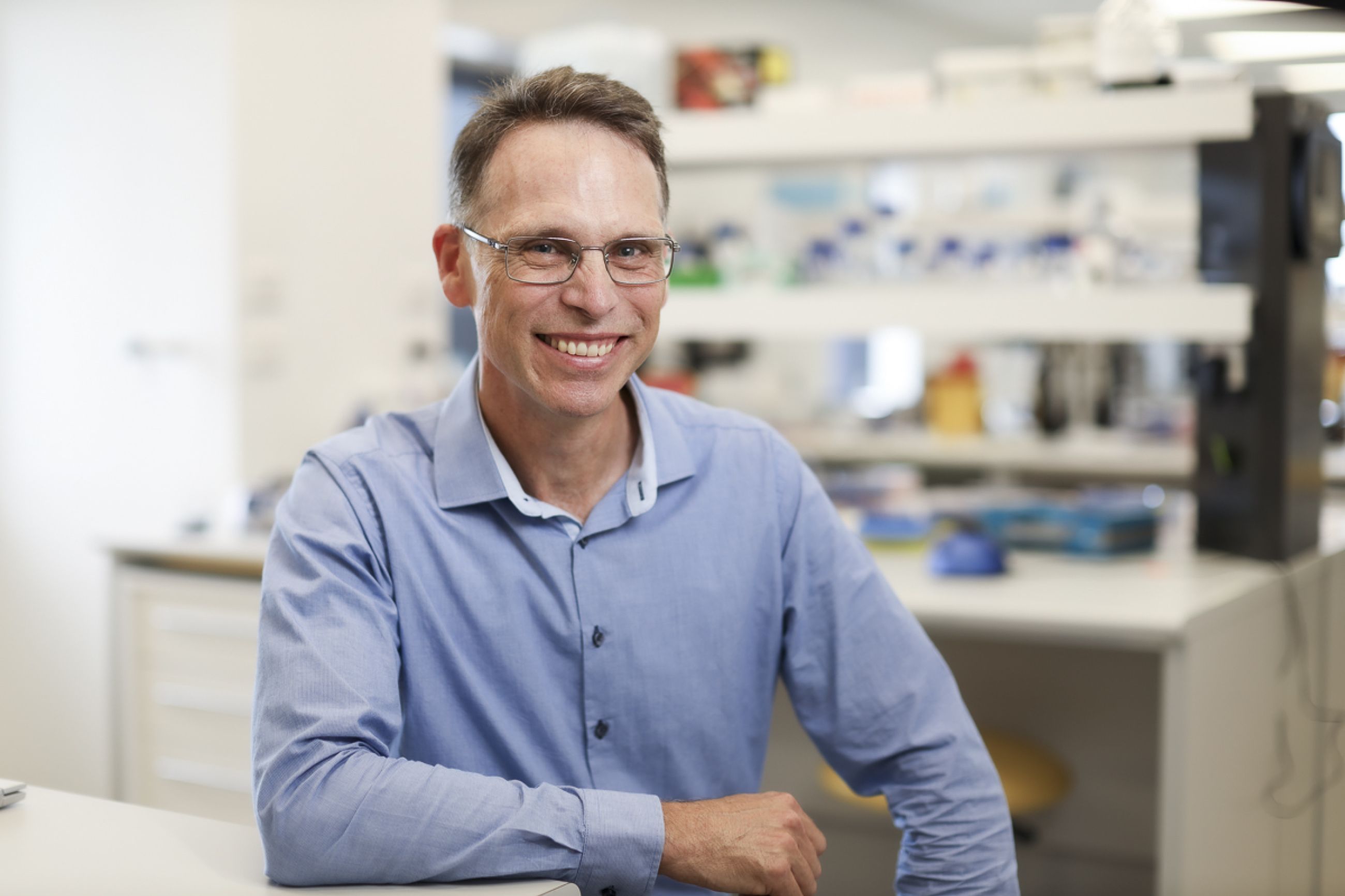
A Children’s Medical Research Institute scientist has been rewarded for taking an innovative approach to solving a gene therapy problem by being awarded a highly competitive NSW Government research grant.
Associate Professor Grant Logan, in CMRI’s Gene Therapy Research Unit, has received Early-Mid Career Researcher funding from the NSW Office for Health and Medical Research for his work to develop a new strategy that will enable greater patient access to potentially life-saving gene therapies.
Gene therapy has proven to be life-changing for many patients who otherwise have few or no treatment options, with spinal muscular atrophy (SMA) patients being one example. SMA is an inherited neuromuscular disorder where children born seemingly healthy gradually lose control of their muscle function and eventually even lose their ability to breathe, with the most severe cases dying within the first two years of life. Gene therapy is changing this outcome with the earliest treated patients now reaching their seventh birthdays.
The most efficient gene delivery systems for this task are vectors based on viruses and the current SMA gene therapy uses a harmless virus named adeno-associated virus (AAV) that has a natural ability to carry genetic information into human cells. Unfortunately, some infants are unable to receive the therapy because their body has natural immunity to the AAV vector. This problem is also an issue for patients with other diseases who could potentially benefit from AAV gene therapy.
Assoc Prof Logan studies the immune response to AAV and is trying to solve this problem. His latest approach is to ‘cloak’ the vector and make it invisible to the immune system.
“Some children and adults have pre-existing immunity to the AAV viral coat protein, from natural exposure to similar viruses circulating in the community,’ he said.
“This is a major obstacle to treatment because it means a proportion of patients cannot receive life-saving AAV-based gene therapies because they have antibodies that neutralise the AAV vector, preventing the gene therapy from entering its target cells.”
“We plan to tackle this challenge head-on by developing small molecules to ‘cloak’ the AAV viral coat, so it can escape neutralisation by the circulating antibodies and successfully enter target tissue to deliver gene therapy.”
Assoc Prof Logan said, if successful, they hoped that the ‘cloaking’ system could be applied to help not only SMA patients but those with conditions such as Duchenne Muscular Dystrophy and other disorders where effective AAV gene therapies are under development.
“It’s a great thrill to receive this funding so that we can address this significant hurdle to give more patients greater access to this amazing technology.”
The Early-Mid Career Grant Program is administered by NSW Health’s Office for Health and Medical Research. The most recent round awarded researchers who specialise in Advanced Therapeutics and who are ready to take their career to the next level by building and leading a multidisciplinary team.