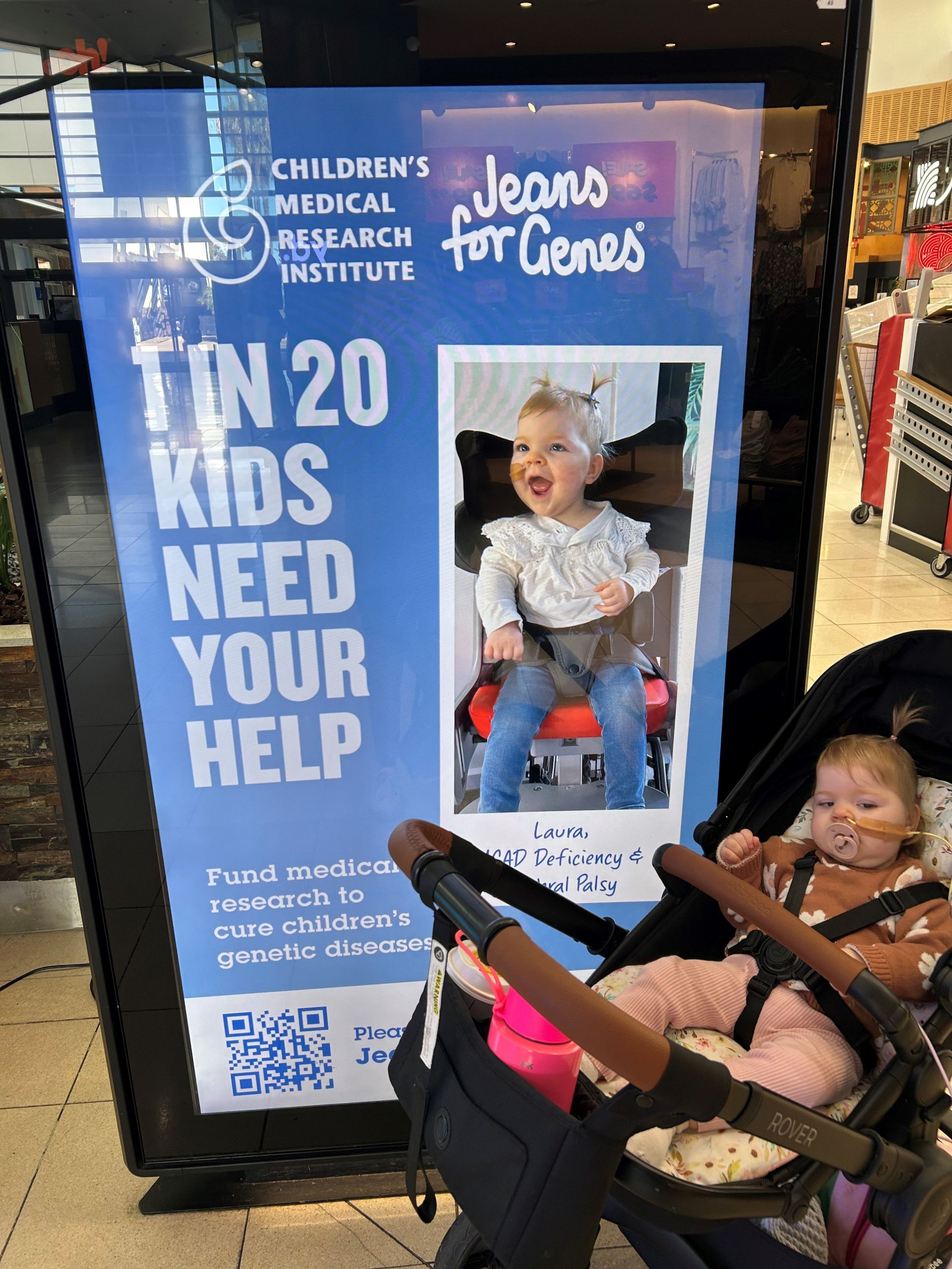
The winner of this year’s Cute Shoot could not be a more gorgeous model for Jeans for Genes, but she has had an exceedingly tough start to life – diagnosed with not just one, but two serious conditions.
Rachel Kaesler was 37 weeks pregnant when she experienced reduced foetal movement and underwent an emergency caesarean to save the life of her daughter, Laura. Shortly after being born, Laura started having multiple seizures, and an MRI revealed she had suffered a stroke.
After more tests, they made the extraordinary discovery that Laura had a blood clot which caused her stroke. She was then diagnosed with cerebral palsy.
“They couldn’t tell us if she would walk or talk, so we just started to adjust to what our life would look like,’’ Rachel said.
Then 10 days later, while Laura was still in hospital, Rachel and her husband Arlen were told that the results of the heel prick test had come back showing that she had medium chain acyl-CoA dehydrogenase (MCAD) deficiency. It is a metabolic condition that impacts the body’s ability to break down certain fats to convert into energy. If blood sugar levels drop, it can lead to coma or death.
“I was really angry,’’ Rachel admits. “This was during Covid, so my husband was at the hospital, and I had to be on the phone, and I just couldn’t comprehend what they were telling us. We’d already been dealt one card and now this. It felt like we’d gone back to square one.’’
The two conditions are not related but both parents are carriers of the gene related to MCAD – which they were completely unaware of.
Rachel and Arlen decided to put their energy into educating others about genetic disorders. Last year, they held a raffle and raised more than $10,000 for Jeans for Genes. This year they decided to enter Laura in the Jeans for Genes Cute Shoot competition to educate their friends and family.
Laura’s image is on a billboard where they live in South Australia and has already been on screens in a shopping centre.
“We tell all our friends, especially the pregnant ones, to just do prenatal genetic testing,’’ Rachel said. “You can have a simple blood test that can pick up a lot of irregularities. This could save their child’s life. If you have a life-threatening illness and you don’t find out for 10 days, then that could be too late.
“We also tell people to invest in research because it would be great if, one day, we could test for every genetic disease. You never think it is going to happen to you, until it does.’’